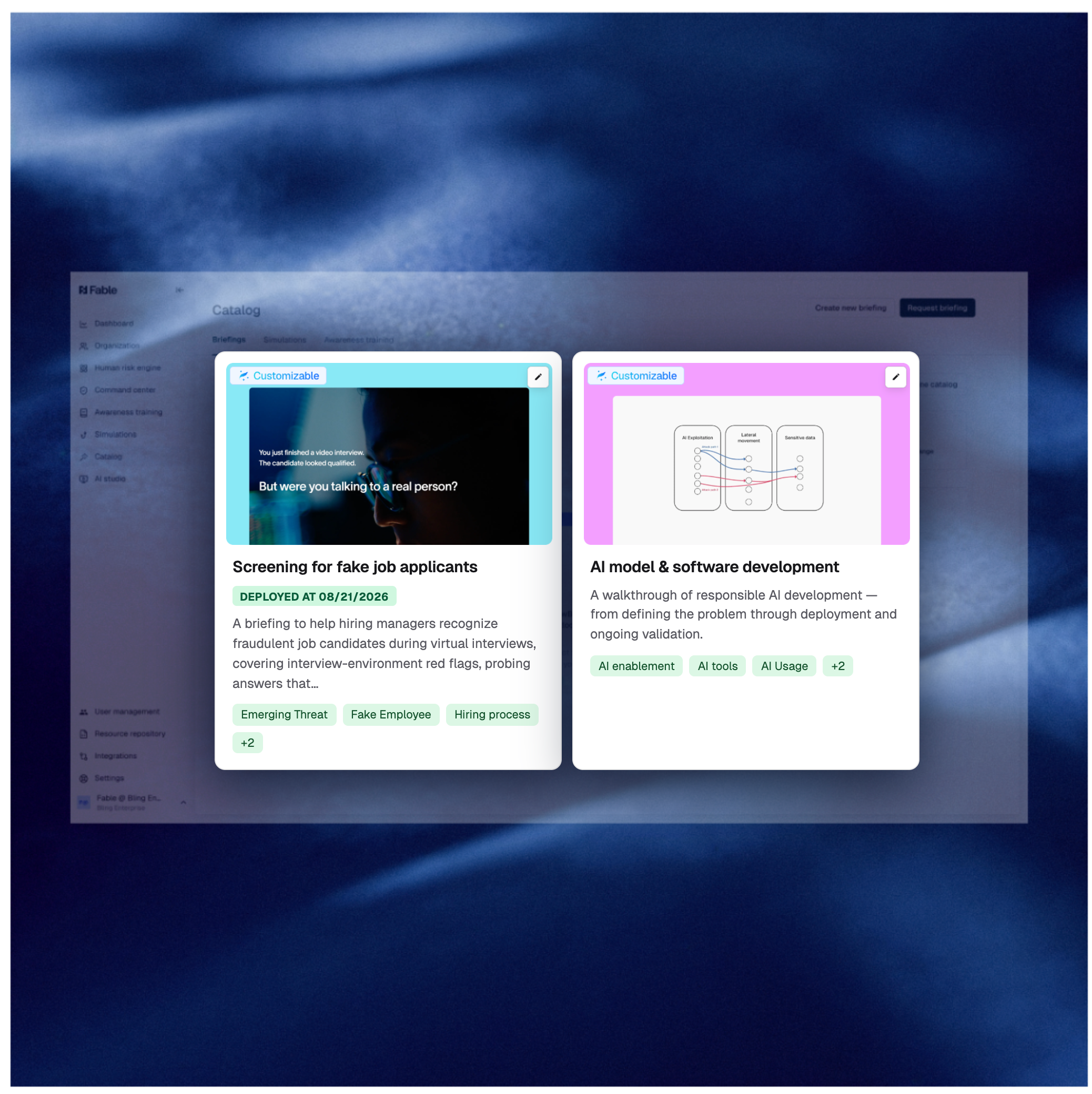
Two new briefings target roles at critical decision points: hiring managers running virtual interviews, and developers building with AI. Hiring-stage fraud is exactly the kind of human risk that generic, one-size-fits-all training misses, and it’s accelerating as attackers use AI to fake resumes, references, and even video interviews to get fraudulent hires inside the perimeter. On the engineering side, AI development without guardrails on approved tools, data handling, and model validation has become one of the fastest-growing sources of policy violations.
What’s new
- Screening for fake job applicants — A briefing that helps hiring managers spot fraudulent candidates during virtual interviews, covering interview-environment red flags, follow-up questions that expose fabricated experience, identity and location inconsistencies, and mismatched online profiles.
- AI model & software development — A walkthrough of responsible AI development for engineers, covering the full lifecycle from problem definition through deployment, with concrete guardrails on approved tools, data handling, model validation, and transparency.
Why it matters
Candidate fraud has moved from edge case to active threat, and hiring managers are the checkpoint. Most have never been trained to read the interview itself as a security signal. This briefing gives them the pattern to catch: eyes fixed off-screen as if reading a prompt, follow-ups that fall apart under scrutiny, IP addresses that don’t match a candidate’s claimed location, and online profiles that contradict their story. One signal means nothing. Five or six stacked in the same candidate is a reason to pause and escalate before onboarding the wrong person.
Responsible AI development is no longer theoretical. Source code accounts for roughly 42% of AI-related data policy violations, and most employees using AI at work do it through personal accounts rather than company-managed ones. This briefing turns AI policy into a concrete engineering reflex: build only when AI is the right tool, use approved systems, never paste proprietary code or confidential data into unapproved chatbots or coding assistants, and validate models for bias and explainability throughout the lifecycle. It gives engineering teams a shared baseline before shipping AI features, not after an incident.
How to access it: These briefings are available in the Fable content catalog. Navigate to the Catalog in the Fable platform to find and deploy them.