



Day 9 of 12 days of riskmas (or, if you prefer, risk-mukah or the non-denominational risk-ivus)
The TL;DR
- Risks that travel together are toxic combinations
- Risk lift measures how often paired risks co-occur versus random chance
- In one case, money handlers who fail phishing tests have a risk lift of nearly 2x
- Targeting overlapping risks can deliver outsized security gains
There will be math. You’ve been warned.
Some risks are dangerous on their own. Others become even more hazardous when they collide. In our human risk report, we focus on toxic combinations: pairs of risky behaviors or exposures that occur together far more often than chance would predict. These overlaps are where security programs tend to lose control quietly, and where attackers find their easiest paths in.
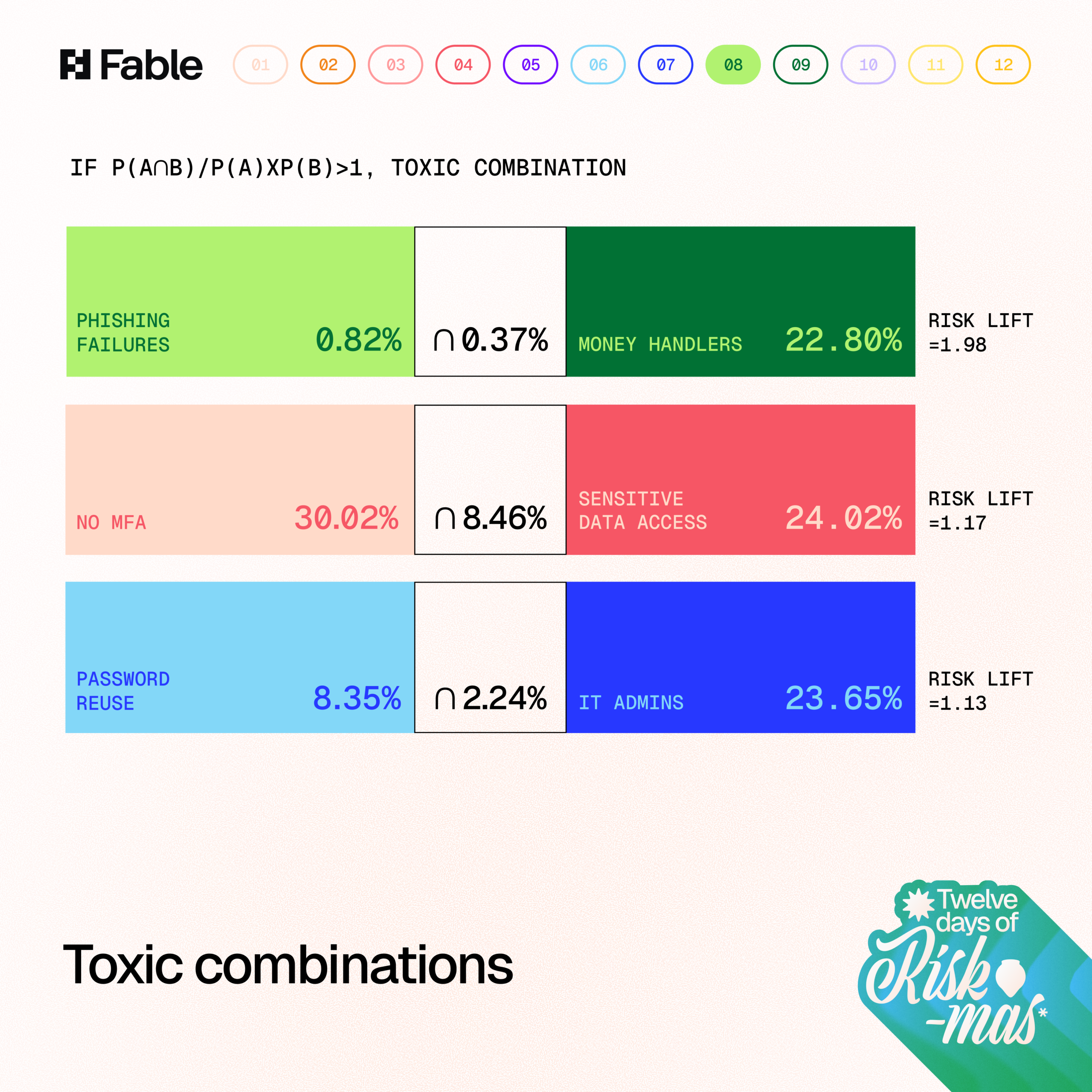
To measure this effect, we look at what we’re calling “risk lift of toxic combinations” (if you think of a more clever name, we’re all ears). In simple terms, it compares how often two risks actually co-occur versus how often they should if they were unrelated. The math is straightforward: P(A∩B)/P(A)×P(B). Anything higher than 1.0 means the co-occurrence is higher than expected, and therefore toxic, meaning they amplify overall exposure.
We took several real-world examples from our anonymized data set, finding in one case that money-handlers who failed phishing simulations show a lift of 1.98—nearly double the overlap you’d expect by chance. That pairing alone signals a dangerous mix of access and susceptibility. In another case, employees with sensitive data access and no multi-factor authentication register a lift of 1.17. And a third example shows IT administrators who reuse passwords coming in at 1.13. Each number may look modest, but they reveal that weaknesses that travel together can stack the risk.
This is the hidden cost of treating risks as independent checkboxes. A phishing failure here, weak authentication there. On paper, each might seem manageable. In reality, the overlap is what matters. That’s where exposure accelerates and where breaches are most likely to begin.
The upside is clarity. Toxic combinations tell security teams exactly where to act. Instead of broad, blunt controls, leaders can target the people and behaviors that deliver the biggest risk reduction for the least effort. Fix the overlaps—not just the outliers—and the payoff compounds fast.
See, that math wasn’t so bad, was it?
Tune in tomorrow for a fun little review about measuring risk.